Imagine a nightclub security guard who is large, commanding and stationed at the entrance with a guest list. If your name appears on the list, you are admitted. If it's not there, you will be refused entry. The security guard doesn't accompany you inside. He doesn't observe what you do when you get inside. He also doesn't find out if you have exchanged clothes with someone on the list. His work is complete at the door.
That is a firewall, basically. For a while, that was sufficient. It has ceased being so.
WHAT A FIREWALL ACTUALLY IS?
Really, in its simplest form, a firewall is a security mechanism that watches and controls the network traffic based on the rules set beforehand. One may say it is a check point separating two networks, more often than not, a private internal network (your home, your company, your server) and the public internet.
Every time data is transferred via a network, it is done in small bits called packets. Besides the data itself, each packet has a header, a label that indicates where it came from, where it's going, what protocol it's using, and what port it's targeting. A firewall inspects those labels and determines: allow or deny.
Such a straightforward matter becomes very complicated when done at a large scale. A large enterprise network can handle millions of packets in one second. The firewall must make the correct decision each time, immediately, without disrupting the flow of genuine business traffic.
That is the core challenge firewalls were built to solve. But the way they solve it has changed dramatically over the past four decades.
THE HISTORY: FROM A UNIVERSITY LAB iN 1988 TO NATION-STATE DEFENCE
Firewalls weren't simply invented on a corporate whiteboard. In fact, they were first created at universities.
Back in 1988, a University of California, Davis graduate student named Conrad Kwok was co-supervised when he developed what many would consider the very first filtering firewall prototype a "cut-through bridge, " as he named it. The bridge acted as a gatekeeper between two networks and its software-controlled the flow of traffic. The device cost about £1,600 in today's money. However, the idea was, well, priceless.
It was a very good time to be working on this kind of technology because, guess what? In November 1988, the Morris Worm, a piece of malware that was capable of self-replicating and spreading all over the internet, infected thousands of Unix computers, paralyzing approximately 10% of all computers connected to the internet. This was a wake-up call and that there was a need for the protection of the rapidly expanding internet.
The word "firewall" came from a physical analogy: a fire-resistant barrier built into walls to stop fire spreading from one room to another. And the analogy was perfect. In a network, a firewall is a tool that stops the spread of harmful and unsafe traffic.
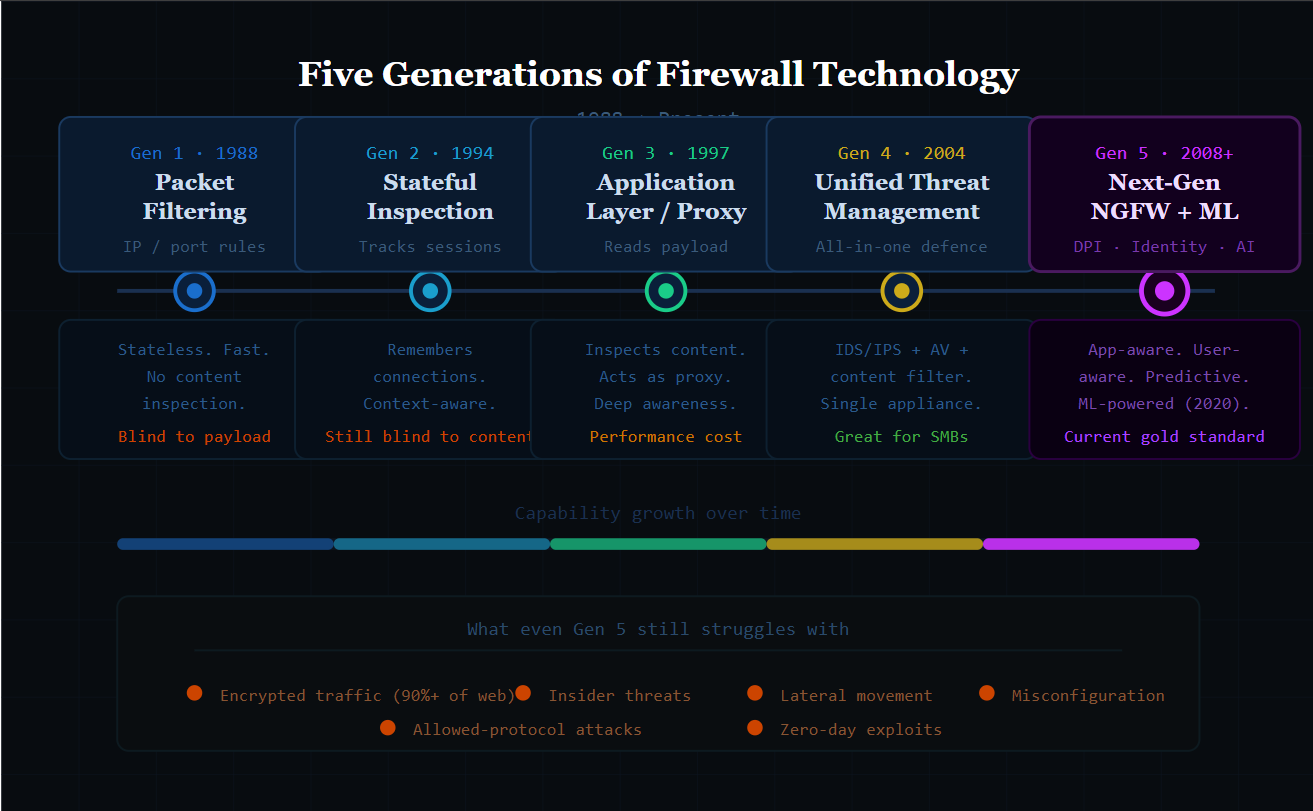
Firewall technology development didn't stop there. Each one was a result of the previous one failing.
THE FIVE GENERATIONS OF FIREWALL TECHNOLOGY
GENERATION 1: PACKET FILTERING (LATE 1980s)
The first generation of firewalls, or packet filtering firewalls as they're also called, first appeared back in the late 1980s. Working at the network layer level, they scrutinized individual packets against a set of pre-established rules, like source and destination IP addresses, ports, and protocols, to decide on allowing or blocking the traffic.
They were very fast and inexpensive. However, they lacked awareness of the whole situation. A packet filtering firewall would behave like it had no memory. Every packet was checked entirely independently, the firewall had no knowledge of what packets might have preceded or succeeded it. Someone out to exploit the system, knowing which ports were open, could send in packets that appeared to be legitimate. The filter would let them pass as if it were nothing.
Such firewalls are described as stateless, and it was discovered that statelessness was a huge security flaw.
GENERATION 2: STATEFUL INSPECTION (EARLY 1990s)
Then memory was given to firewalls as the next step.
Stateful inspection firewalls not only tracked the states of new network connections but also maintained a table of ongoing conversations so that based on the sequence number, the window size, the acknowledgment number, the source and destination ports and addresses, etc., they could distinguish between a legitimate reply to a request and an intrusion attempt.
It was a breakthrough, for sure. However, stateful firewalls had a major limitation. They were aware of connections but not of content. They were capable of telling which port was used for a conversation, but what was exchanged during that conversation was a mystery to them.
GENERATION 3: APPLICATION LAYER & PROXY FIREWALLS (MID-1990s)
As the internet grew rapidly in the mid-1990s, the bad guys figured out how to be sneakier. They started to create malware that looks like normal web paths like sending bad stuff hidden in a(n) (plain) web communication, because they knew that most firewalls wouldn't check into.
Application layer firewalls changed the game. These are also called proxy firewalls. They did a great job as a mediator they first caught the traffic, then they looked at what was really inside, and finally they decided if they should let it go through or not. A firewall could, for the first time, understand the message, not just who was talking to whom.
The price was the speed. Thorough checking took it causes time, and those days of the early internet, that delay was felt.
GENERATION 4: UNIFIED THREAT MANAGEMENT (EARLY 2000s)
Since the early 2000s, Unified Threat Management (UTM) systems have started to appear, bringing together several security functions in one single appliance, mixing the usual firewall features with intrusion detection and prevention, antivirus, and content filtering.
UTM really made a difference for small and medium businesses. Instead of controlling five different security tools, a company could simply gather them all in one box. It was a logical progression motivated by the increasing complexity of the real world.
GENERATION 5: NEXT-GENERATION FIREWALLS (2008–PRESENT)
The advent of NGFWs in 2008 marked a major departure of network devices that were only passive before. With NGFWs as standard, network security systems could carry out deeper inspections and take security decisions in real time on the basis of thorough data analysis.
Next-Generation Firewalls (NGFWs) combined all the features of the previous generation and added capabilities that would have been considered a work of fiction in 1988 such as deep packet inspection, application awareness, identity-based controls, integrated intrusion prevention, and the latest machine learning.
There has been a major change in the firewall landscape in the early 2020s in the form of ML-Powered NGFWs. These firewalls incorporate machine learning to predict threats and provide better protection for the network transforming firewalls from reactionary tools into systems that can detect even the modern threats and their variants before a signature is created.
WHAT A FIREWALL SEES: THE TECHNICAL REALITY
Traditional firewalls simply look at basic information on packets, such as source and destination addresses. However, modern firewalls or Next-Generation Firewalls (NGFWs) are much more sophisticated in that they analyze communication across the layers of the OSI model from the lowest Layer 1 that involves physical transmission of data to the highest Layer 7 where applications do their work.
So, whenever a packet or memory packet passes through a modern NGFW, the firewall is capable of doing the following:
- Packet header analysis: Reading source/destination IPs, ports, and protocols. The baseline that all firewalls have always performed.
- Stateful connection tracking: Maintaining a table of active sessions to understand the context of each packet in relation to the conversation it belongs to.
- Deep Packet Inspection (DPI): Opening the packet and reading its payload. Identifying the actual application in use, regardless of what port it claims to be using. This is how a firewall can spot a VPN tunnel disguised as web traffic, or peer-to-peer software pretending to be HTTP.
- Application awareness: Identifying not just which port is being used, but which actual application is responsible, distinguishing between, say, a WhatsApp call and a browser session, even if both travel on the same port.
- Identity integration: In enterprise environments, NGFWs can link traffic to specific user identities rather than just IP addresses. This means a policy can say "this department cannot access this application", not just "this IP address cannot reach this port."
- Threat intelligence feeds: Cross-referencing traffic against continuously updated databases of known malicious IP addresses, domains, and file signatures.
WHAT A FIREWALL BLOCKS: THE WINS
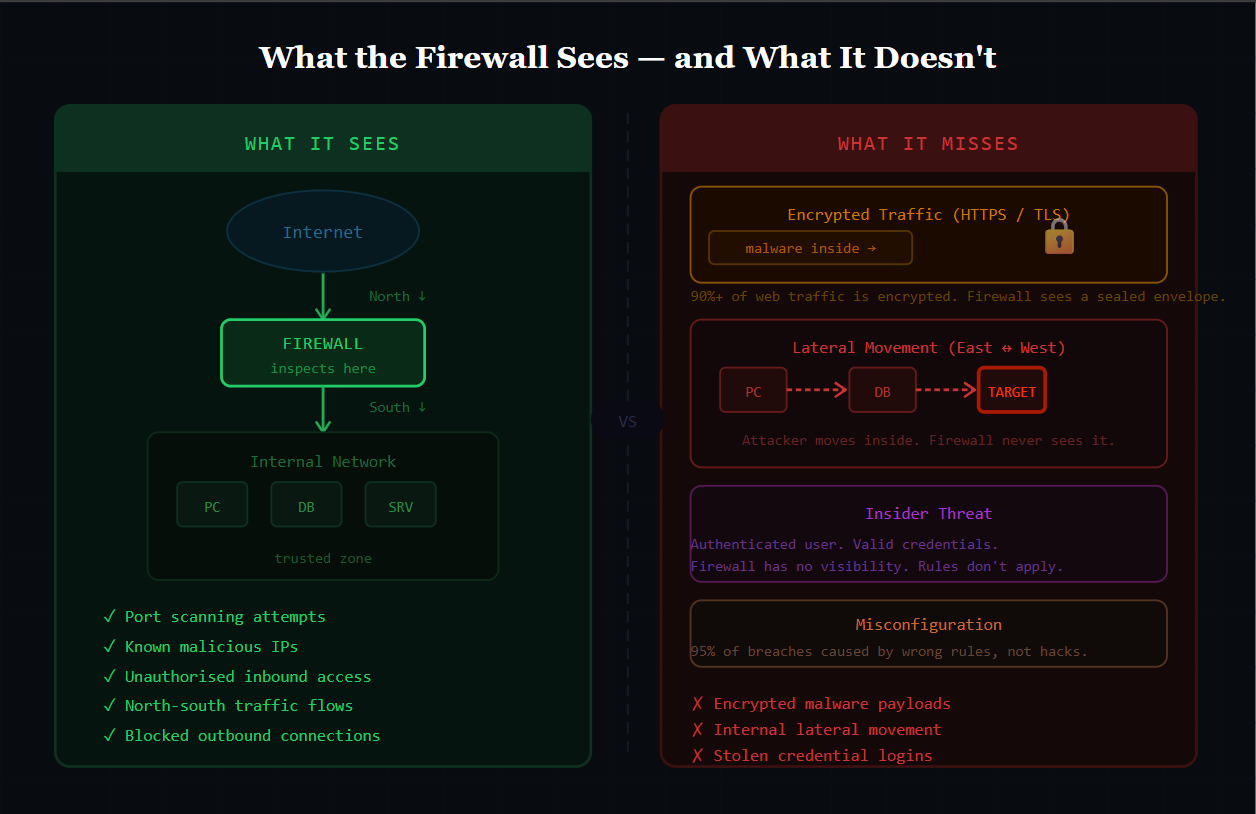
When configured correctly, a modern firewall is genuinely powerful. It stops:
- Unauthorised access attempts from external IP addresses
- Port scanning by reconnaissance tools looking for open doors
- Known malware signatures in inbound and outbound traffic
- Traffic to known malicious domains, commands, and control servers
- Data exfiltration attempts through unusual outbound connections
- Network-layer DDoS attacks by rate-limiting or blocking flood traffic from identified sources
- Lateral movement between network segments when micro-segmentation is in place
In fact, a firewall that has been properly set up is a very effective and absolutely necessary defence against the majority of opportunistic, automated attacks that simply spray the internet looking for vulnerable targets. It makes the cost of attack high enough for most automated threats to decide to move on to softer targets.
WHAT A FIREWALL MISSES: THE TRUTHS NOBODY TELLS YOU
This is the firewalls story that nearly never gets included in the beginner's guide. And it is actually the most important part.
1. IT CANNOT SEE INSIDE ENCRYPTED TRAFFIC, AND MOST TRAFFIC IS NOW ENCRYPTED
About 90% of the web traffic that we use daily is encrypted these days. However, firewalls manage to decrypt just a very small part of this traffic because of limitations related to performance and also due to privacy issues. Hackers take advantage of this situation by hiding their malicious code in HTTPS or QUIC traffic.
Encryption means a firewall can only see the outside of a sealed envelope. It can only check the envelope's origin and destination, it has no idea what is inside unless it opens the envelope first by decryption. Some NGFWs do SSL/TLS inspection by positioning themselves as a "man-in-the-middle" who decrypts, inspects, and re-encrypts the traffic. However, this is really demanding in terms of computing power, in some locations, legally a bit of a minefield, and quite far from being universally done.
Threats that come via files like Gootloader and QakBot often use popular cloud apps like Microsoft 365 or Slack as a channel to spread the malware that passes through encrypted channels without firewalls ever detecting it.
Simply put: if through an encrypted connection to a trusted service an attacker conceals a harmful payload, most firewalls will just let it go.
2. IT HAS NO DEFENCE AGAINST INSIDER THREATS
Addressing insider threats remains a major blind spot for enterprise firewalls. Lateral movements or suspicious user activities, including those from authenticated users, are beyond the scope of firewalls which mostly depend on specifying external-internal traffic rules. The design of a firewall is based on one key assumption: dangers come from outside. If someone gets inside the network be it a legitimate employee, a contractor, or an attacker who has compromised the credentials of a valid user the firewall will hardly be able to control what happens next.
When users are given too many privileges, they can even bypass the perimeter defences without any help from the firewall. Once inside the internal network, they could either steal data or wreak havoc on the digital infrastructure. This is not a mistake but a very fact of the architecture. Firewalls serve to monitor the perimeter as that was their main function. Making sure the inside is orderly is a whole different story!
3. MISCONFIGURATION IS ACTUALLY THE REAL THREAT AND IT'S LITERALLY EVERYWHERE.
That should be one statistic that really makes every security professional squirm: according to Gartner's report, it's misconfiguration that is responsible for 95% of all firewall breaches, not defects.
Not sophisticated zero-day exploits. Not hackers from nation-states armed with unlimited budgets. Misconfiguration. A rule set incorrectly. A port opened when it shouldn't be. An "any-any" rule, that is allow all traffic from any source to any destination, tucked away in a policy from six years ago that nobody thought to review since.
One out of five firewalls have at least one configuration problem. The 2019 Capital One breach, that was the result of a single misconfigured firewall rule made public the personal information of over 100 million people. It was not a highly sophisticated attack on the firewall itself. Just one wrong rule.
4. IT CANNOT STOP ATTACKS THAT USE ALLOWED PROTOCOLS
Think of a firewall as a gate that only lets through people that have a pass. If the rule says that people are allowed to use the gate at 443 port, then the firewall will let those people through. What it doesn't know and usually cannot figure out even after several configurations is if the ones who use that channel of web traffic are the ones with the legitimate browser or the attackers, the latter using that permitted channel to take out your data or give commands to the malware that is already inside your network.
That's what C2 (Command and Control) attacks are all about. The malware that has been put on a computer inside the organization tries pulling a fast one by making a home call through ordinary-looking HTTPS requests. For the firewall, it's as if an employee is simply browsing the web. For the attacker, it's a wide-open channel.
5. IT DETECTS INBOUND AND OUTBOUND TRAFFIC BUT NOT EAST-WEST TRAFFIC
Traditional firewall architecture is primarily designed around controlling north-south traffic, that is, the traffic that enters or leaves the network. The protection provided for east-west traffic, the communication between the systems that are located within the same network, is much weaker.
Since a flat network can be easily traversed by a single infected malware or even a rogue device, direct access to essential assets can be gained. Once inside, attackers can move laterally, locate credentials, and increase their privileges silently and without much resistance.
This is known as lateral movement, and it's the method of operation behind nearly every significant ransomware attack. The first point of entry is hardly ever the target system, it's usually a less-secured machine in the vicinity. The attacker continues to move stealthily from one machine to another, residing inside the network for days or weeks, until finally reaching their main target. No perimeter firewall will be capable of preventing this. It was simply not geared for that purpose.
THE CAPITAL ONE LESSON: THE HUMAN FACTOR
Back in 2019, a hacker enormously capitalized on a misconfigured Web Application Firewall to carry out a Server-Side Request Forgery (SSRF) attack without physically breaking the firewall at all to gain entry into Capital One's cloud infrastructure. Very simply, the firewall had been wrongly set up by a human. That human mistake literally opened the door. As a result, 106 million customer records were leaked.
The take-home message here is not that firewalls don't work. The truth is a firewall can only be as robust as the rules that someone made for it and those rules are made by humans, under the pressure of time, with limited knowledge, in constantly changing environments. Actually, the firewall did the job as per the configuration. The problem was with the configuration itself.
THE BIGGER PICTURE: THE PERIMETER IS NO LONGER ENOUGH
Network security for years was designed like a castle. The firewall was the fence. Everything inside was trusted. Everything outside was not trusted. The model was simple, clear, and efficient, if all the work was done in the same building, on the same network, and all the data was stored on-site. Unfortunately, that is not the case anymore. Cloud apps are everywhere, employees can work anywhere, partners are connected as first-class citizens, and criminals do not even wait at the drawbridge for a polite invitation.
Today's cybercriminals do not necessarily have to break into the company's systems by carrying out an attack on a firewall. What they usually do is log in using stolen credentials. According to the Verizon 2024 Data Breach Investigations Report, approximately 68% of breaches involved a non-malicious human element, including the use of stolen credentials, phishing, and social engineering.
The castle is wall-less now. The moat is dry. And the firewall, standing at a perimeter that does not exist anymore, is guarding a boundary that attackers simply do not need to go around. This situation caused a totally new security philosophy to emerge: Zero Trust.
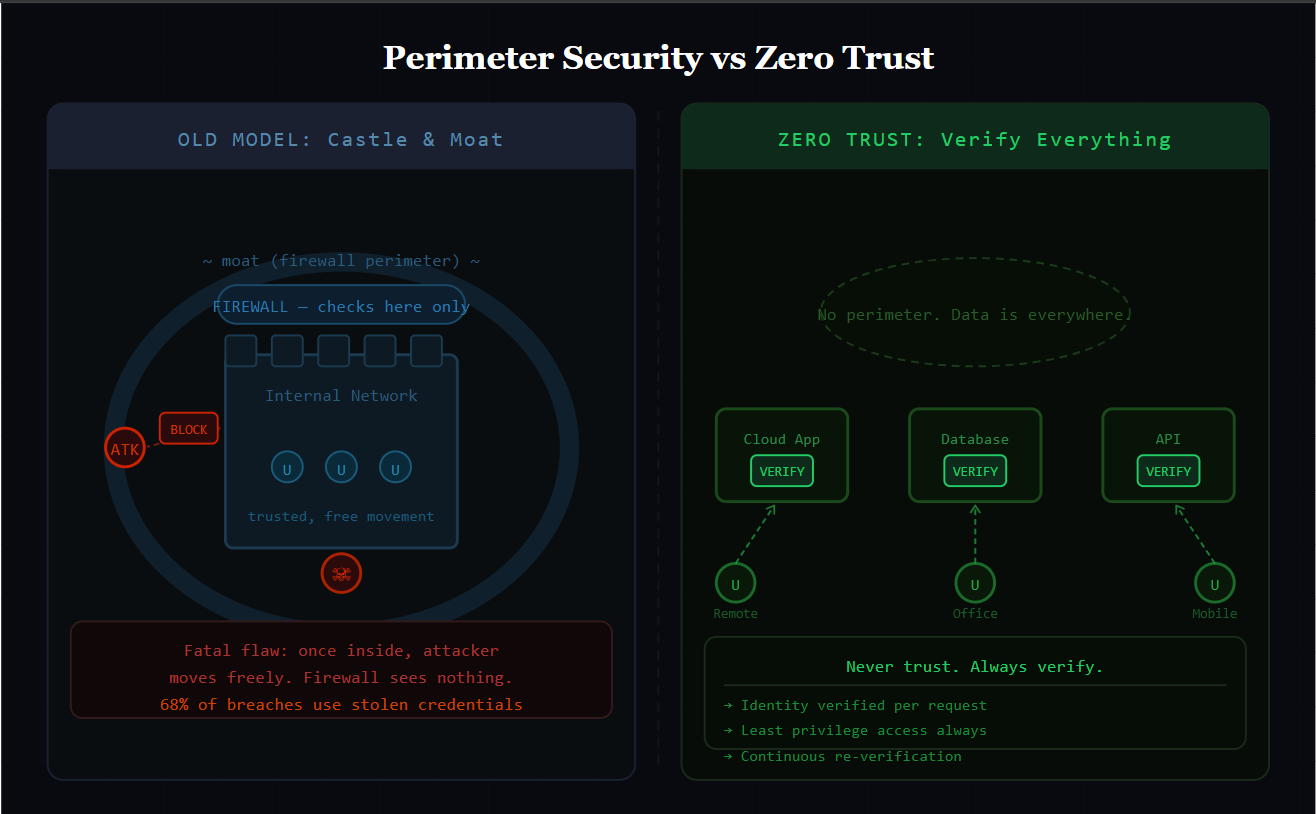
The idea is simple, although the deliveries may be complex: be cautious at every step, verify every time, and never trust without verification. A Zero Trust model requires that every individual, device, and network connection be verified and authenticated, whether they are inside or outside the traditional network perimeter. Access is not granted based on geography but on identity, device health, and context, and it is constantly re-assessed, not just recline at the door. Firewalls continue to have an important role in the modern world. But firewalls continue to be a part of the security ecosystem, it's just that they are not the focus anymore. They are one of several control elements, not the only gatekeeper of trust.
WHAT THIS MEANS FOR YOU
If you run a small business, a home network, or a big company, these practical tips apply to you:
- Don't rely on your firewall as your only defence. A firewall is like a gatekeeper, not a full security plan. Support it with endpoint protection, intrusion detection, email security, and most importantly, user training.
- Keep checking your firewall rules. Unused, unnecessary, or too loose rules will pile up, and that will be where attackers get in. If you have rules that no one understands, get rid of them.
- Turn on SSL/TLS inspection if possible. Encrypted traffic is nowadays the top choice of malware to hide in. Give your firewall the green light for decrypting and inspecting if it has that function.
- Set up network segmentation. Avoid a flat internal network where all devices can communicate with each other. Limit the access to sensitive systems, so that an attacker won't be able to compromise the entire network just by moving from one compromised device to another.
- Go beyond the perimeter. It's not only about asking "who's trying to get in?" but also "what if someone is already in?" Organisations that ask the second question and build their defences accordingly are the ones that breach survivors rather than being breached victims.
THE FIREWALL IS NOT THE ENEMY OF NUANCE
The firewall is a truly remarkable bit of technology. What started as a university campus prototype in 1988 has developed to a security engine that uses machine learning in 2025. It halts millions of automated attacks every single day without anyone even noticing. It is a fundamental the element of every serious network security stack.
Yet it is not a promise. It is not a fortification that excludes all evil from entering. It is a very capable guard at a certain point, one that can be tricked by the right credentials, circumvented by the right protocols, and weakened by the wrong configuration.
Knowing what your firewall truly detects, what it blocks, and, most importantly, what it fails to detect is not a reason to fear it. It is a reason to develop a security strategy that goes beyond it. The wall is there. It is important. But the actual security tale has always been about the events behind it.
Did you find it useful? Share it with those who think that firewall is basically security, this might start a very necessary discussion. Also, subscribe to our newsletter for more fascinating info on cybersecurity that even experts may not know.
Comments