
If you have followed this series, you already know the core instinct of an infrastructure engineer. We do not start with the application a user sees. We start at the bottom of the stack and work up, because that is where the real constraints live. A website is only as available as the server beneath it. A server is only as reachable as the network beneath that. Control, capability, and failure all originate in the layers underneath, and they cascade upward.
I want to take that same instinct, the one we have been applying to packets and protocols all series, and point it at artificial intelligence. Because when you look at AI through an infrastructure lens rather than a software one, something becomes clear that the louder conversations tend to miss.
AI is not really a software story. It is an infrastructure story. And like any infrastructure story, the interesting question is not what happens at the top, where the applications and the headlines are. It is what happens at the bottom, where the chips, the data centres, and the electricity are. That is the layer I find most revealing, because infrastructure does not lie. You cannot argue with a power grid that has no spare capacity, or with a chip that only a handful of companies on earth can manufacture. Let us look at what AI actually runs on, why those foundational layers concentrate so much control, and what the long history of critical infrastructure tells us tends to happen next.
The Part Nobody Sees: AI Is a Physical Thing
When you send a prompt to an AI system, the interaction feels weightless. You type a question, wait a moment, and an answer appears. It feels like pure software, like something happening in an abstract cloud somewhere.
It is not. Every AI prompt depends on a physical stack: chips, data centres, electricity, cooling, water, land, and grid capacity. That weightless little interaction on your screen is the visible tip of an enormous, power-hungry, physical supply chain. AI is no longer only a software story. It is an infrastructure story, and increasingly, it is an energy story.
The scale is hard to overstate. The United States alone hosts more than 5,400 AI data centres, over ten times the count of any other country. Global data-centre electricity demand rose by 17 percent in 2025, and the electricity consumption of AI-focused data centres specifically surged by around 50 percent in a single year. A single fully-populated AI server rack, with eight high-performance GPUs, can draw 12 to 15 kilowatts of continuous power. Multiply that across hundreds or thousands of racks in a single facility, and one data centre can consume tens or hundreds of megawatts, the output of a small power station.

To understand why this matters for the question of control, you have to understand that this physical stack has layers, and each layer has a chokepoint. A chokepoint is a place where a small number of actors control something that everyone else absolutely depends on. Chokepoints are where power concentrates. And AI infrastructure is full of them.
The Five Layers of the Machine
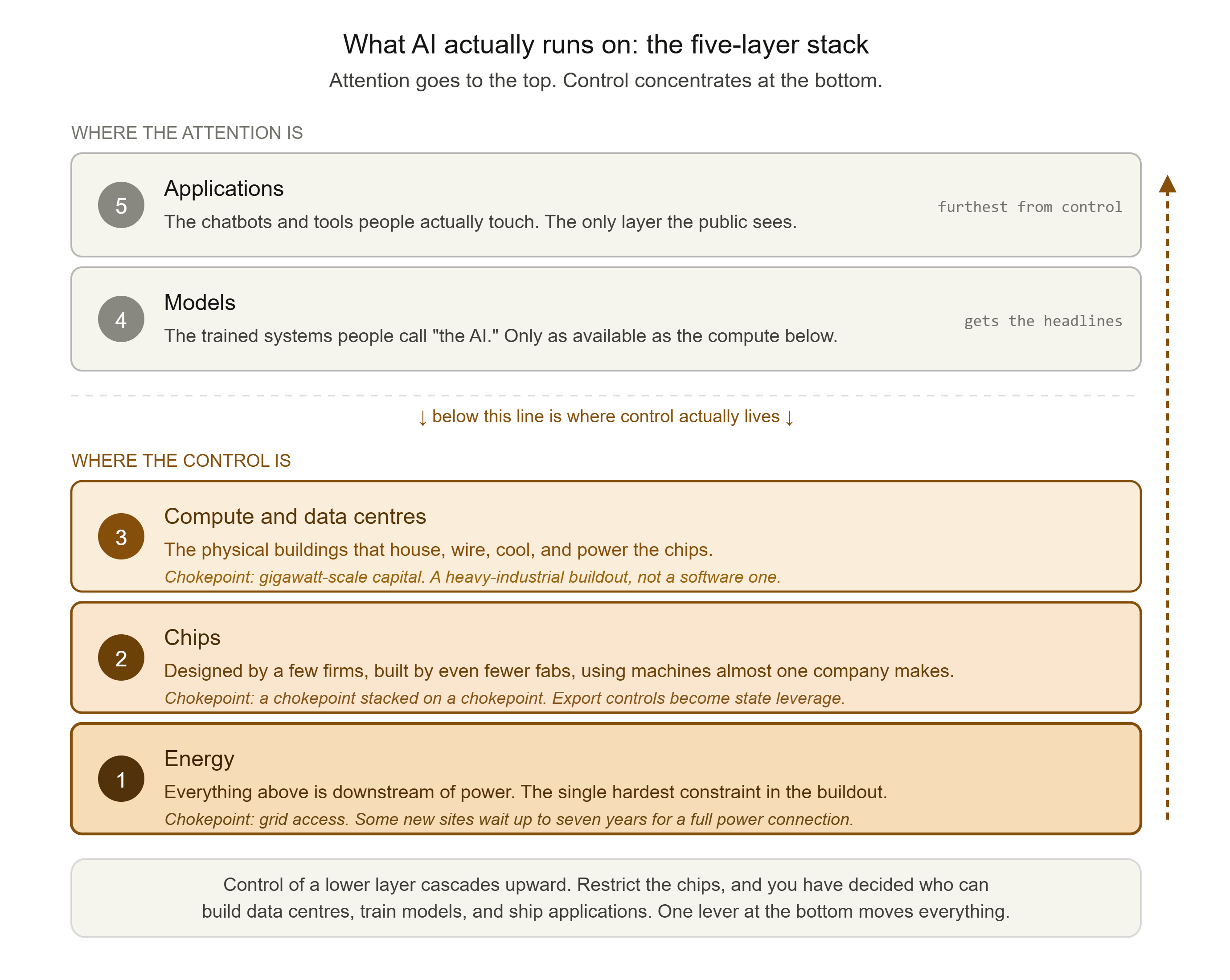
Let us walk up the stack, from the ground to the application, because each layer is a potential lever of control.
Layer 1: Energy
At the very bottom sits electricity. Everything above it is downstream of power. And power, it turns out, is now the single hardest constraint in the entire AI buildout.
The single biggest chokepoint in the AI buildout is not silicon, not software, and not capital. It is electricity. In the major data-centre hubs, the waiting times to connect a new facility to the electrical grid have become extraordinary. In Loudoun County, Virginia, the largest data-centre hub on earth, the local utility has warned that some new projects could wait up to seven years for a full power connection. Grid interconnection timelines in places like Northern Virginia and Dublin now stretch to 2028 and beyond.
This has changed the nature of the industry. "Speed to power" has become the single most important factor in whether a data-centre project is even viable. By early 2026, analysts were describing the moment AI infrastructure became fundamentally energy-constrained: the binding limit was no longer demand, and no longer even capital, but control over electrons. Whoever controls power generation and grid access controls the pace at which AI can grow. That is an enormous lever, and it sits largely in the hands of utilities and the governments that regulate them.
Layer 2: The Chips
Above energy sits silicon. This is the layer most people have at least heard about, because of the prominence of companies like NVIDIA. But the chokepoint here is tighter and stranger than most people realise.
The most advanced AI chips in the world are designed by a tiny handful of companies, and they are manufactured by an even tinier handful of fabrication plants, using machines that essentially one company on earth knows how to build. The chips inside AI servers run so hot that ordinary air conditioning cannot cool them. Without specialised liquid cooling delivered through precision-engineered piping, the chips overheat in minutes and destroy themselves. That cooling hardware has its own waitlist, currently running into 2027.
This is a chokepoint stacked on a chokepoint. A few chip designers, depending on a few fabricators, depending on a few makers of fabrication equipment, depending on a few suppliers of cooling and memory. Each link in that chain is a place where control can be exercised, whether by a company hoarding supply or a government restricting exports. This is exactly why chip export controls have become one of the most significant instruments of state power in the last few years. When you can decide who is allowed to buy the machines that make intelligence possible, you hold real leverage.
Layer 3: Compute and Data Centres
Above the chips sits the compute layer: the physical data centres that house the chips, wire them together, cool them, and feed them power. This is where the raw computational capacity available to developers and researchers is actually determined.
Building these facilities has become one of the largest capital undertakings of our time. By early 2026, global commitments to AI and data-centre infrastructure had crossed hundreds of billions of dollars in a single quarter, with gigawatt-scale campuses, facilities measured by the power of a major power plant, becoming normal across the United States, Europe, and Asia. Private capital giants have committed over 100 billion dollars to building AI-ready data centres. This is no longer a software industry funded by venture capital. It is a heavy-industrial buildout on the scale of national infrastructure projects.
Layer 4: The Models
Above the data centres sit the models themselves, the trained systems that most people think of as "the AI." This is the layer that gets the headlines and the public attention. But notice that it sits near the top of the stack, dependent on everything beneath it. A model is only as available as the compute it runs on, which is only as available as the chips and the power underneath that.
Layer 5: The Applications
At the very top sits the application layer, the chatbots, assistants, and tools that ordinary people actually touch. This is the only layer most of the public ever sees, and it is the layer furthest from the physical reality that makes it possible.
The crucial insight is this: control does not live at the top, where the attention is. It lives at the bottom, where the power and the silicon are. Anyone who wants to control AI, whether a corporation or a state, does not need to control the apps. They need to control the layers underneath.
And here is why that is so powerful: the layers are stacked, so control of a lower layer cascades upward. Restrict who can buy advanced chips, and you have indirectly decided who can build data centres, which decides who can train frontier models, which decides who can offer applications. A single lever at the bottom moves everything above it. This is what makes infrastructure such an efficient instrument of power. You do not need to regulate a thousand applications if you control the one resource all of them depend on. Ask yourself: if you wanted to shape the entire AI industry with a single decision, where in the stack would you place your hand?

Why Infrastructure Attracts the State
Here is the pattern that history teaches us, and it is remarkably consistent. When a technology becomes critical enough that a society cannot function without it, governments stop treating it as an ordinary business and start treating it as strategic infrastructure. And once something is strategic infrastructure, the state gets involved, every single time. The only question is how.
This is not new, and it is not unique to AI. Consider the precedents.
The railroads, in their day, were the defining infrastructure of the industrial economy. At their peak they employed around two million American workers and made up roughly a twelfth of the entire economy. When they were considered critical to the war effort, the US government took direct control of them during the First World War, and again briefly during the Second. The principle was simple: infrastructure this essential could not be left entirely to private hands during a crisis.
Steel was nationalised, briefly, by President Truman in 1952 to prevent a strike from crippling production during the Korean War. The logic was identical: when the nation depends on it, the state asserts control.
Nuclear technology is perhaps the clearest case of all. It was developed under direct government control from its very inception, through a wartime government program, and private nuclear capability has only ever been permitted since then under stringent regulatory frameworks. No private actor has ever been allowed to develop nuclear weapons. The state claimed the commanding heights from day one and never let go.
And then there is the most striking parallel of all: the internet itself. The internet emerged from government-funded research before commercial actors built the public network on top of it. And even today, the government operates entirely separate classified networks, physically and logically walled off from the commercial internet, for its own critical functions. The state funded the foundation, let private industry build the public layer, and kept a sovereign capability of its own.
Across every one of these cases, railroads, steel, nuclear, the internet, the same arc appears. A technology becomes essential. The state recognises it as strategic. And control, in some form, follows. The mechanism varies, from outright nationalisation to regulation to direct ownership stakes, but the direction is the same.
There is no reason to expect AI to be the exception. If anything, the case for state involvement is stronger, because AI infrastructure combines several things governments already treat as strategic: advanced computing, energy, and critical supply chains, all in one.
The Pattern Playing Out Right Now
Here is where recent events fit in, and I want to handle them the way an engineer handles any data: as evidence of a pattern, not as a verdict on anyone. The point is not who is doing this or whether it is good or bad. The point is that it matches the structural logic exactly.
Over the course of 2025 and into 2026, the US government shifted from being a grantmaker, handing out subsidies, to being a direct capital provider, taking actual ownership stakes in strategically important companies. Legal analysts described this as the "visible hand" of government becoming a defining feature of the financing landscape.
The examples are concrete and verifiable. The government took a stake of nearly 10 percent in a major chipmaker, converting earlier subsidy commitments into actual equity, with a warrant to acquire more. In the rare-earths sector, the Department of Defense paid 400 million dollars for an effective 15 percent stake in a mining company, becoming its largest shareholder, and paired that with a guarantee to protect it against foreign price manipulation. Across the quantum-computing sector, the government committed more than 2 billion dollars in 2026 across nine companies, taking a minority, non-controlling equity stake in each as a condition of the funding. By that point the state's investment portfolio openly spanned semiconductors, steel, nuclear energy, rare earths, and quantum computing. The pattern moved methodically across exactly the sectors a national-security planner would prioritise.
This is the moment to pause and ask the obvious question: what do all of those sectors have in common? None of them is a consumer product. Every one is foundational infrastructure or strategic input, the layers other industries are built on top of. The state was not buying into the visible economy. It was buying into the floor beneath it.
The open question, the one being debated right now, is whether this approach extends to the largest AI companies themselves. If it does, it would mark the moment the experiment moved from strategic minerals and chipmakers to what one analysis called the crown jewels of the equity market.
I want to be careful here, because this is where verified fact ends and speculation begins, and the honest thing is to mark that line clearly. Whether any specific AI company ends up with government ownership, and on what terms, is genuinely unsettled, and it is not my place or my interest to predict it. The legal mechanism by which a company would voluntarily hand over stock is itself unclear. What the structural lens can say with confidence is narrower and more durable: foundational infrastructure attracts this kind of attention, and AI infrastructure is now foundational. The direction of travel follows from the structure, regardless of who is in office or what they decide.
The Real Tension: Regulator, Customer, Investor, Owner
Here is where the infrastructure lens reveals something the surface debate misses.
When any government takes an ownership stake in a company whose product it also regulates, buys, and depends on for national security, the roles begin to blur in a way that is structurally difficult to manage. This is not a comment on any particular administration. It is a feature of the arrangement itself, and it would be true whoever held office and whichever company was involved. The same entity can end up being the regulator, the customer, the investor, and the owner, all at once. Each of those roles has different and sometimes opposing incentives. A regulator wants to constrain. An owner wants the value to grow. A customer wants low prices. A national-security stakeholder wants control and secrecy. Putting all four in the same hands creates tensions that are hard to resolve cleanly.
Consider how one chief executive described his own company's deal after the government became its largest shareholder. He insisted plainly that it was not a nationalisation, that the company still controlled its own destiny, that it remained shareholder-driven. He may well be right. But notice what the very need to say it reveals: when the state becomes your largest shareholder, the question of who is really in control stops being obvious enough to leave unspoken. The reassurance is itself the evidence that the line has blurred.
This is the structural problem at the heart of the entire question, and it is far more interesting than the simple "companies versus governments" framing. The issue is not who wins. The issue is that as AI becomes critical infrastructure, the neat separation between the state and the industry, the separation that much of the modern economy quietly assumes, starts to dissolve. And once it dissolves, you have to answer hard questions about accountability, competition, and power that the old categories were designed to keep separate.
Why This Matters Even If You Never Touch the Infrastructure
You might reasonably ask why any of this matters to an ordinary person, a developer, or a small business, none of whom will ever own a data centre or a chip fabrication plant.
It matters because infrastructure is destiny. The entity that controls the foundational layers of AI, the compute, the chips, the energy, gets to set the terms for everyone building on top. They decide who gets access to compute and at what price. They decide which uses are permitted. They decide, ultimately, what can and cannot be built. If you are a developer building on top of someone else's AI infrastructure, your freedom to operate is defined by decisions made several layers below you, in places you have no visibility into and no vote over.
I have felt this personally, and I wrote about it once already. In an earlier post, Are AI Companies Monetising Our Desperation?, I described hitting usage limits on an AI tool I was paying for, upgrading, and hitting them again, and asking whether the pricing was quietly exploiting how dependent I had become at exactly the wrong moment. At the time I framed it as a pricing question. The infrastructure lens is the structural answer to that personal frustration. The wall I kept running into was real compute, real electricity, and real cost at the bottom of the stack, but where exactly that wall was placed was a decision made several layers below me, in a room I would never see. The lived experience of being throttled as a user and the structural reality of who controls the foundational layers are the same story, told from opposite ends of the stack.
This is the same lesson that runs through the networking series this post is a brief detour from. Whoever controls the lower layers of any system controls what is possible at the higher layers. In networking, that is about packets and protocols and who can see your traffic. In AI, it is about compute and chips and energy and who can decide what gets computed. The principle is identical. Power concentrates at the bottom of the stack, and it flows upward.
The people watching only the top layer, the apps, the models, the corporate dramas, are watching the shadow. The substance is underneath, in the unglamorous world of power contracts, fabrication capacity, grid connections, and now, government equity stakes. That is where the future is actually being decided.
The Question Worth Sitting With
So what does the infrastructure lens actually tell us, once we strip away the noise at the top of the stack?
It tells us that the most consequential decisions about AI are probably not the ones being announced about models and capabilities. They are the quieter ones being made about the foundational layers: who gets compute and at what price, who can access advanced chips, who controls the power that everything else depends on. Those decisions sit several layers below the applications most people are watching, and yet they set the boundaries for everything built above.
This is the same lesson that runs through the entire networking series this post is a brief detour from. In networking, control concentrates in the lower layers and flows upward, which is why understanding those layers matters so much for security. In AI, the principle is identical, just scaled up from packets and routers to chips and power grids. Whoever holds the bottom of the stack shapes what is possible at the top. That is not a political claim. It is an engineering one, and it has been true of every critical system humans have ever built.
So the questions worth sitting with are the structural ones, the kind an engineer asks about any system. If controlling the bottom of a stack means controlling what runs at the top, where in the AI stack does real leverage actually sit? If the foundational layers, compute, chips, and energy, become concentrated, what does that mean for everyone building on top of them? And if infrastructure shapes what is possible, then which layer should you be watching to understand where AI is really heading: the visible applications, or the physical foundations beneath them?
That is the story worth following. Not the fireworks at the top of the stack, but the quiet, decisive contest at the bottom. Watch the infrastructure. It will tell you where the power is going long before the headlines do.
This was a standalone analysis, a brief detour from our Networking Foundations series, which continues in the next post with IP addressing and subnetting. If this gave you a new way to see AI, as an infrastructure story rather than only a software one, share it with someone still watching only the top of the stack. And subscribe to our newsletter for more analysis that looks underneath the surface.
Comments